
By Iconic | Published 25 October 2026 | Updated 25 October 2026 | 6 min read
| Quick answerIn October 2026, Iraq’s Council of Ministers approved removing customs duties on imported solar energy systems. Duties were as high as 33% before a cut to 5% in February 2026. Lower duty means more solar panels, lithium batteries and inverters entering Iraq through Umm Qasr, Basra, Ibrahim Khalil and Erbil Airport. For Iraq logistics, that means growing demand for dangerous goods handling, fragile-cargo transport and customs clearance. Iconic, an Erbil-based freight forwarder operating since 2010, handles all three. |
Key takeaways
- Duty path: 33% before February 2026, then 5%, then removal approved in October 2026.
- Open point: no implementation deadline has been published. Confirm the effective date and tariff codes with Iraqi Customs before you ship.
- Volume outlook: Iraq had about 42 MW of installed solar at the end of 2024 and targets 12 GW by 2030. Expect sustained growth in solar cargo.
- Hardest cargo: lithium batteries (Class 9 dangerous goods) and fragile PV modules. Both need specialist handling.
What did Iraq decide on solar import duties?
Iraq’s Council of Ministers approved the removal of customs duties on imported solar energy systems in October 2026, according to the Iraqi News Agency report carried by Iraq Business News. The decision followed a proposal from the Ministry of Electricity submitted to the Prime Minister on 23 September 2026.
It is the second cut this year. In February 2026 the Customs Authority lowered the duty from 33% to 5% on PV panels, inverters, cables and lithium batteries, as pv magazine reported. Global Trade Alert dates that change to 22 February 2026.
| Date | Customs duty on solar systems | Status |
| Before February 2026 | Up to 33% | Replaced |
| 22 February 2026 | 5% (PV panels, cables, inverters, lithium batteries) | In force |
| October 2026 | Removal of duties | Approved by Cabinet. No implementation deadline published |
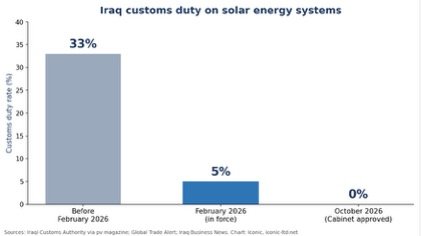
Iraq’s customs duty on solar energy systems, before and after the 2026 decisions.
Two caveats for importers
- Timing: TaiyangNews reports that the Council of Ministers has not specified an implementation deadline.
- Scope: outlets describe the covered goods differently. PVTIME describes household-scale hardware, others say solar energy systems generally. Confirm covered HS codes with Iraqi Customs.
Separately, the Ministry of Electricity’s 40-article draft on smart-meter grid connection and energy exchange is with the State Council for legal review. It is not yet approved.
How much more cargo will the zero-tariff decision add to Iraq logistics?
Facts. No official freight forecast exists. Iraq’s cumulative solar capacity was about 42 MW at the end of 2024, according to IRENA data cited by pv magazine. The stated target is 12 GW by 2030.
Iconic’s view. Closing that gap needs a continuous flow of containers, trucks and air cargo, not a one-off spike. We expect demand in three waves:
- Household and small commercial rooftop systems: many small consignments of panels, inverters and batteries.
- Industrial and agricultural installations: mid-size projects with scheduled deliveries and site access to plan.
- Utility-scale projects: full-container and project cargo movements with fixed delivery windows.
What the duty cut means in money. This is an illustration of the arithmetic only. On cargo with a customs value of USD 100,000, duty at 33% is USD 33,000, at 5% is USD 5,000, and at zero is nil. Actual duty depends on the customs valuation, and other charges still apply.
What does solar cargo need from an Iraq logistics provider?
| Cargo | Main risk | What good logistics looks like |
| Solar PV modules | Glass breakage, hidden micro-cracks, moisture | Correct palletizing and container loading plan, limited stacking, covered storage, careful last-mile trucking, photo records at loading and delivery |
| Lithium batteries and BESS | Class 9 dangerous goods: UN3480, UN3481, UN3536 for batteries installed in a cargo transport unit | Correct DG classification and documents, compliant packing and labelling, approved carriers, safe storage |
| Inverters | Shock, moisture, tight project schedules | Original packaging kept intact, serial numbers matched to documents, fast clearance, scheduled delivery to site |
Solar PV modules
Panels are glass laminates. Micro-cracks are often invisible on delivery and show up later as lost output. The loading plan, edge protection and handling at every transfer matter more than the freight rate. Photograph the cargo at loading and again on arrival, and insure it.
Lithium batteries and energy storage systems
Lithium-ion and LiFePO4 batteries are Class 9 dangerous goods. Stand-alone batteries are UN3480, batteries packed with or contained in equipment are UN3481, and batteries installed in a cargo transport unit, such as many containerized storage systems, are UN3536. Shippers need a safety data sheet and a UN 38.3 test summary. By air, stand-alone lithium-ion batteries (UN3480) can only travel on cargo aircraft, with state of charge limited to 30%.
Inverters
Inverters are not usually dangerous goods, but they are sensitive power electronics. Keep original packaging, make sure serial numbers match the packing list and invoice, and clear them quickly so installation crews are not left waiting.
Which routes carry solar cargo into Iraq?
- Sea: Umm Qasr and Basra for containerized panels, batteries and inverters from Asia. See our update on the Al Faw Grand Port.
- Land: Ibrahim Khalil and other northern border crossings for cargo moving via Turkey into Erbil and the Kurdistan Region.
- Air: Erbil and Baghdad for urgent inverters, controllers and samples. Read how Erbil Airport customs clearance speed affects air cargo.
Checklist: importing solar panels, batteries and inverters into Iraq
- Confirm the current duty status, effective date and HS codes with Iraqi Customs or your broker.
- Prepare the commercial invoice, packing list and certificate of origin. Electronic verification through ASYCUDA has been mandatory since 10 July 2026. See our guide to Iraq’s electronic certificate of origin verification.
- For batteries, get the safety data sheet and UN 38.3 test summary from the manufacturer before booking.
- Agree the Incoterm (for example FOB, CIF or DAP) so responsibility for freight, customs clearance and delivery is clear.
- Book a loading plan and cargo insurance suited to fragile and high-value equipment.
- Plan the final leg: site access, unloading equipment and delivery windows. Read the Iraq Customs Clearance Guide 2026 and our note on advance customs duty deductions.
Iconic’s role in Iraq’s renewable energy supply chain
Iconic is a freight forwarding and logistics company headquartered in Erbil, Kurdistan Region of Iraq, operating since 2010. We provide air, land and sea freight, customs clearance, project cargo, warehousing and supply chain management across Iraq and Middle Eastern and Eurasian trade corridors. We have handled imports of solar panels, lithium batteries and inverters into Iraq, and we manage:
- Customs clearance under the current tariff rules, including documentation and electronic verification.
- Dangerous goods batteries, from classification and paperwork to compliant transport.
- Fragile PV cargo, from the loading plan to site delivery.
- Project cargo coordination with shipment tracking from origin to Erbil, Baghdad, Basra or the project site.
Planning a solar shipment into Iraq? Contact the Iconic team at www.iconic-ltd.net for freight and customs solutions for renewable energy cargo.
Frequently asked questions about Iraq logistics and solar imports
Has Iraq removed customs duties on solar panels?
Yes. Iraq’s Council of Ministers approved removing customs duties on imported solar energy systems in October 2026. No implementation deadline has been published, so confirm the effective date and covered tariff codes with the Iraqi Customs Authority before shipping.
What was the customs duty on solar panels in Iraq before the change?
Up to 33%. It was cut to 5% in February 2026 for PV panels, cables, inverters and lithium batteries, before the October 2026 decision to remove it.
Will the zero-tariff decision increase freight volumes into Iraq?
Iconic expects sustained growth in container, trucking and air cargo flows, although no official freight forecast has been published. Iraq had about 42 MW of installed solar at the end of 2024 and a stated target of 12 GW by 2030.
Are solar batteries dangerous goods?
Yes. Lithium-ion and LiFePO4 batteries are Class 9 dangerous goods (UN3480, UN3481, or UN3536 when installed in a cargo transport unit) and need compliant packing, labelling and documentation.
Which ports and borders handle solar imports into Iraq?
Umm Qasr and Basra by sea, Ibrahim Khalil and other border crossings by land, and Erbil and Baghdad airports by air.
What documents are needed to import solar panels into Iraq?
Typically a commercial invoice, packing list and certificate of origin, with electronic verification through ASYCUDA mandatory since 10 July 2026. Lithium batteries also need safety data sheets and UN 38.3 test summaries. Confirm the full list with your customs broker.
Can Iconic handle solar panel, battery and inverter shipments to Iraq?
Yes. Iconic provides freight forwarding, customs clearance, dangerous goods handling and delivery for renewable energy cargo in Iraq, from its base in Erbil.
Sources
- Iraq Business News: Zero Tariffs on Imported Solar Systems in Iraq (22 October 2026)
- SolarQuarter: Iraq Removes Customs Duties On Imported Solar Energy Systems
- Renewables Now: Iraq removes customs duties on solar equipment
- TaiyangNews: Iraq Scraps Customs Duty On Solar Energy Systems
- PVTIME: Zero import tariffs open up Iraq’s solar sector
- pv magazine: Iraq slashes solar import tariffs to 5%
- Global Trade Alert: Iraq reduces customs duty on solar energy supplies to 5%